Score review
Nonsense Word Decoding · item 140:03
“blim” Hear correct pronunciation
Student’s response
Listen again
AI-assigned score:
✓ CorrectIncorrectUnusable
Designed to capture what traditional assessment never could. Validated for how modern learners actually work. Built for cultural and linguistic fairness from the ground up.
We started with contemporary CHC theory and the latest research on learning disabilities and built from there. The battery spans all of the CHC broad abilities and the academic domains identified under IDEA, covering the full range of skills that matter for understanding how students learn and perform. We grounded it in universal design principles that promote fairness and expand accessibility for everyone.
See the blueprint →Today’s students have widely varied linguistic and acculturative knowledge experiences. We designed the assessment to minimize unnecessary language and cultural demands: abstract shapes instead of culturally-bound imagery, pictures instead of words, and tapping/clicking instead of speaking whenever possible. Animated instructions are also available in other languages, helping ensure that we are measuring the skills we intend to measure rather than someone’s ability to comprehend the task.
The first test designed for today’s learning environment: typing, touchscreens, and speaking, along with curriculum-based fine-motor tasks. Results describe how the student works in the classroom, not just in a testing room.
Academic tasks are sampled from grade-level expectations aligned to national standards and IDEA criteria, so results apply directly to the student's learning environment.
Processing speed, working memory, and visual-motor integration are measured inside real academic tasks as well as abstract ones, so you can spot a weakness that reaches the classroom from one that doesn't.
Tasks preserve classroom conditions by design. Tests like Handwritten Letter Fluency and Keyboarding Fluency isolate the specific skills of the modern learner so a breakdown can be precisely pinpointed.
Every score connects to real-world functioning at school or home.
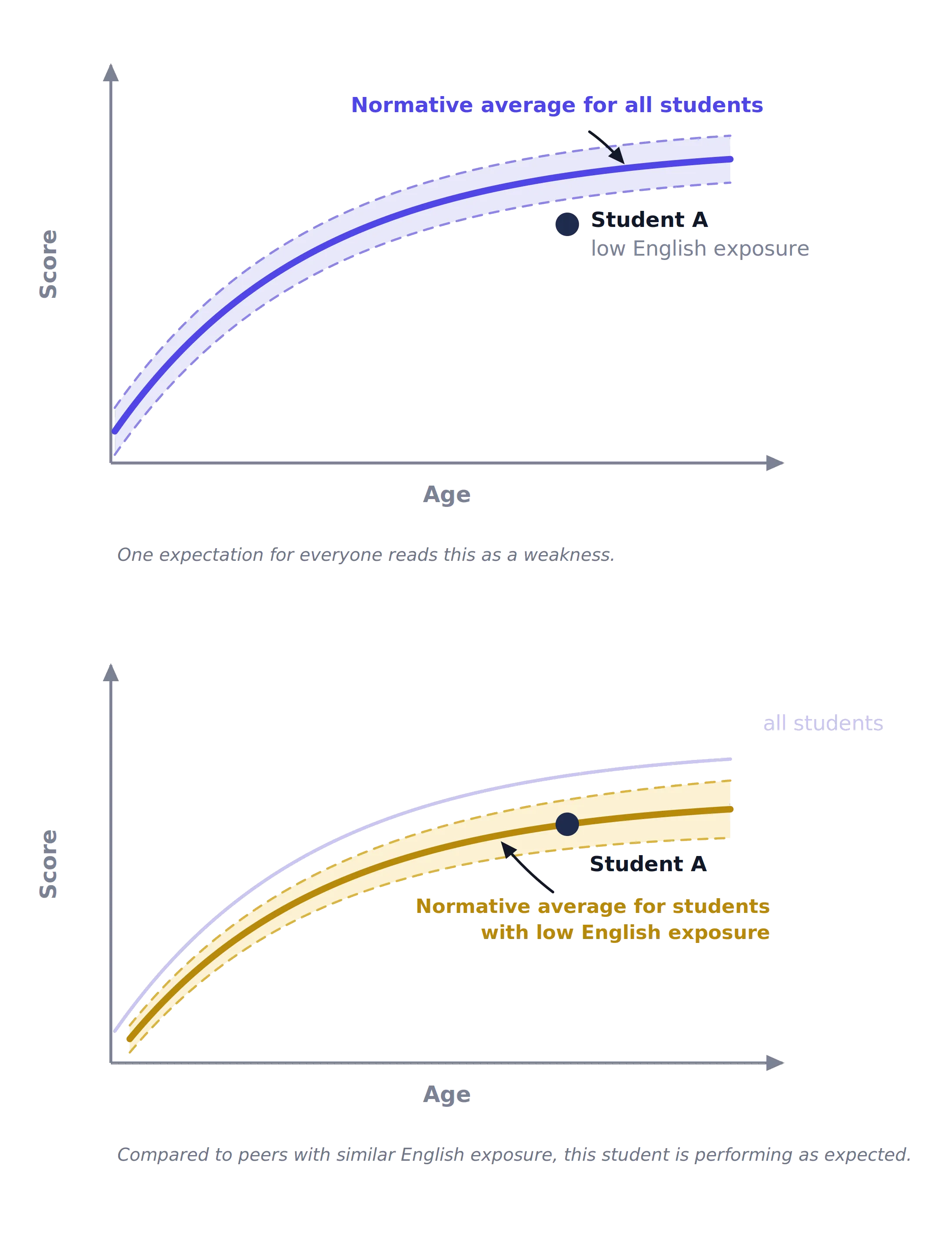
Our norms are designed to reflect today’s diverse student population. We combine state-of-the-art continuous norming methodology with a large, carefully selected normative sample to produce scores that are precise, current, and representative.
We listened back to thousands of administrations during our early research, and we found scoring errors that traditional paper batteries would have left undetected, findings consistent with decades of studies on examiner administration errors.
AI-assisted scoring reduces the examiner’s workload and automates time-consuming scoring tasks, while rigorous validation and ongoing quality checks help ensure that scores remain accurate, consistent, and trustworthy.
Traditional assessments capture the outcome: how many questions a student answers correctly. Marker Method is capturing what happens along the way. We analyze response times, error types, and response patterns to reveal how students approach tasks. We believe these patterns can provide additional clinically meaningful insights beyond the traditional score.
Under study now: Does response rhythm carry clinical signal?
Response rhythm reveals self-monitoring strategies
After each test, we ask students how they felt about the experience: how tired it made them, how much they enjoyed it. Across thousands of students, these simple check-ins will help us explore how motivation, self-efficacy, and engagement relate to performance, adding the student’s perspective to the story told by their scores.
Our research doesn’t stop at building a better assessment. By harnessing the rich data generated through Marker Method, we’re exploring new questions about learning, assessment, and student performance while contributing insights that can advance the broader field.
With appropriate longitudinal follow-up, evaluation data can be connected with later measures such as classroom data, report cards, and state assessments. Over time, that evidence can help answer a question the field has struggled to measure at scale:
Does an evaluation change a child’s trajectory?